Will California Bullet Train Travel Be Worthwhile?
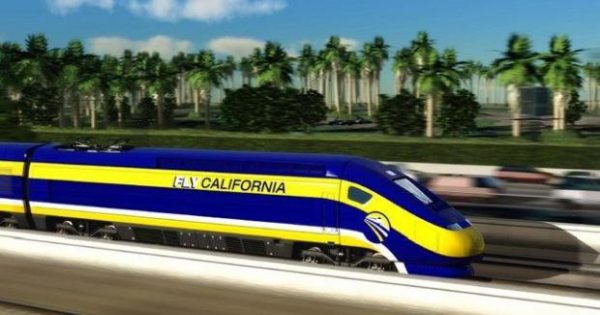
They were first seen in farmers markets. Next, they were asking for signatures outside big-box stores. Finally, the young idealists successfully rallied the people behind the idea of the California High-Speed Rail, also known as the California Bullet Train, a massive project that would allow passengers to ride between Los Angeles Union Station and San Francisco's Transbay Transit Center in a mere 2 hours and 40 minutes. They also plan to build extra tracks going down through Anaheim, all the way to San Diego in the south, and an alternate track running to Sacramento in the north. For many, this sounds like a dream come true. However, it might be time to admit that the project may only work in theory.
How Off-Track Has This Gone?
Earlier this year, it was announced that the cost of building 119 miles of track in the Central Valley has already surged beyond the original estimate of $6 billion. It is now $10.6 billion, and the project has barely begun, despite construction being approved by California's Governor Jerry Brown in 2012. These cost estimates are just for the Central Valley. The current conservative estimates of the total cost of the project are now at $98 billion, more than double what the voters approved in Proposition 1A back in 2008.
Possibly worst of all, the project won't be completed until 2029, when those young idealists will be in or near their forties, and Jerry Brown, the governor who made this all possible, will be at least retired and might even, by then, be riding the great train tracks in the sky. With the astounding speed new technology develops these days, the California High-Speed Rail might even be obsolete before they're done building it.
How Will the Train Be Worth This Hassle?
Let's take a step back from all the insane statistics of failure. What do we want from a California bullet train, in the beautiful, hypothetical future where the undertaking is successful? Is there any one thing, aside from the massive convenience of the quick travel time, that will make riders choose a train over an even shorter flight? Many airlines have been offering cheap in-state flights for years, so how can the California High-Speed Rail compete?
One option is to give the passengers room to breathe. While those who stand to profit from the train may want to pack riders in like sardines, much like the coach section on most commercial flights, the ability to stretch their legs out could certainly sway even devoted members of Frequent Flyer's programs. However, there may be a rush to recoup all the money spent on the project. Those at the top might think the easiest way to do this would be to cram as many seats as possible onto the train, then charge as much as they think people will pay for them. If they do this, the whole endeavor could fail, wasting billions of taxpayer dollars and two decades of planning and hard work. Very few people will choose a longer travel time if both cost and comfort are comparable to the less time-consuming option.
As an alternative, to both boost income and attract riders, the California High-Speed Rail needs to have Wi-Fi, or whatever new internet connectivity may be available in 2029. They can charge a usage fee, just like most airlines do. This way, people can while away the commute on their phones, playing their games, reading their emails, or even completing their
traffic school online. Many people hate flying, for a variety of reasons. If they are given a traveling option that is almost as fast as flying but more comfortable and just as secure, they will be happy to pay an extra five or ten bucks for the Wi-Fi. This will allow the project to remain financially feasible, and all the critics will have to admit the trials and tribulations were worth it in the end. Ultimately, California will remain a leader in new and innovative technology.
What do the Oscar Winners Drive?

If you happened to be watching T.V. last Sunday, you may have caught one of the most popular events of the year. The 2018 Oscars reeled in last year’s most noteworthy films for one night of celebration. Now that everyone can stop guessing who will win which Oscar, the real guessing can begin. What do the Oscar winners drive?
Most people think the Oscars end when celebrities win their awards. Unsuspecting to them, that’s when real speculation begins. We know who won the Oscars, but what we don’t know is what the Oscar winners drive! You know that Myimprov.com is obsessed with cars. Our version of the Oscars is when we discover what car people drive.
[framed_box]
Frances McDormand
Best Actress Oscar winner, Frances McDormand, clearly drives a Mercedes-Benz G-Class. Her acting career is built just like the car she drives, classy and durable. If her powerful performance in Three Billboards was of any indication, McDormand would drive the car equivalent of a giant box.
[/framed_box]
[framed_box]
Gary Oldman
Known for his roles in True Romance and Tinker Tailor Soldier Spy, you may have seen Gary Oldman in his most recent film, The Darkest Hour, reprising his Oscar winning role for Best Actor. Therefore, he would drive a 2018 Dodge Grand Caravan. The idea of Gary Oldman driving a 2018 Dodge Grand Caravan might seem preposterous. But, Gary Oldman only drives the latest and greatest minivans.
[/framed_box]
[framed_box]
Guillermo del Toro
Guillermo del Toro deserved his title of Oscar winner for Best Director. He directed the film The Shape of Water, which told the captivating love story between a woman and sea creature. That’s why we speculate Guillermo del Toro drives a 2018 Honda CRV. With spacious room, compact design, and 28 miles per gallon in the city, there’s no reason why Guillermo del Toro wouldn’t drive a red 2018 Honda CRV.
[/framed_box]
[framed_box]
Jordan Peele
One of the most praised films of 2017 was Jordan Peele’s original screenplay, Get Out. That’s why he won the Oscar for Best Original Screenplay last Sunday. Coincidentally, his victory and nominations solidified our theory that he drives a Chevrolet Express 2500 Cargo Van. He might need a lot of room to fit his Oscar trophy, so that’s why we would assume Jordan Peele drives a van used to ship large boxes.
[/framed_box]
[framed_box]
Allison Janney
Oscar winner of Best Supporting Actress for her role in the film I, Tonya, Allison Janney is an inspiration to many. That’s why we believe Allison Janney would drive the most inspiring car of all, the 2018 Toyota Camry. With a combined 34 miles per gallon, front wheel drive, and compact - yet spacious - room, the Toyota Camry is the #2nd most popular sedan, but the most inspirational sedan.
[/framed_box]
[framed_box]
Sam Rockwell
Sam Rockwell won Best Supporting Actor for his role in Three Billboards. With a performance like none other in his category, Rockwell would obviously drive a car like none other: the Honda Fit. The Fit is a hatchback that is roomy and versatile to meet the needs of the driver - just like Sam Rockwell.
One thing that makes these Oscar winners stand-out among other celebrity drivers is they all completed the best
defensive driving courses online NY has to offer. They know that getting a traffic citation could end their acting career and their good driver career. But, they won’t sweat when paying their car insurance. The reason being, taking a defensive driving course keeps your annual insurance rate from increasing when you receive a traffic citation.
For us, choosing the next Oscar winner is challenging. The real joy in finding out who wins an Oscar is speculating the car they drive.
[/framed_box]
What’s Better: Ride Cabin or Driving?
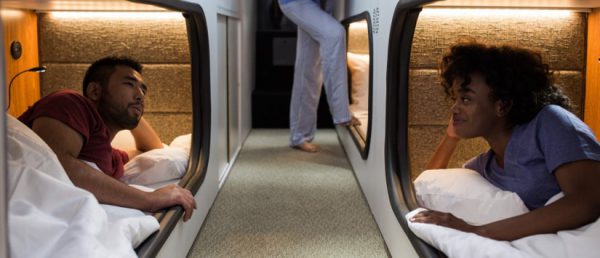
You may be familiar with the revolutionary mode of transportation that recently sprung up in California. Ride cabin is a unique travel experience where passengers rent out private pods known as “cabins” while they ride between Los Angeles and San Francisco in a giant mega bus. What sounds like a perfect setting for a Black Mirror episode is a convenient way to travel between metropolitan areas.
But, is it better than driving?
As always, we ask the hard-hitting questions that plague everyone’s mind. Especially when it comes to futuristic modes of transportation. We’re weighing the pros and the cons of whether it’s better to drive between Los Angeles and San Francisco or to sleep travel in a Cabin.
Driving Between Los Angeles and San Francisco
[framed_box]
Pros:
When you’re driving, you can take your time. You can cruise and enjoy the environmental beauty by taking the PCH or take I-5. Driving your own car allows you take as much freedom as you want between your destinations. You can even take a pit stop to make conversation with the crazy mountain cannibals.
You also won’t need to worry about luggage room. At least, you’ll have more room to fit your clothes, necessities, kitchen sink, or other important travel goods. You will even have the option to pick up a hitchhiker along the way.
Finally, you’ll be able to rock out to your own playlist. It’s nearly a 7-hour trip between the cities, so you have plenty of time to practice your singing, air drums, or choreographic seat dancing during your exhausting drive.
[/framed_box]
[framed_box]
Cons:

It’s a 7-hour trip. Did you read that correctly? 7-hours. Do you want to drive for 7-hours? That’s only one way! You’ll have to make that drive again when you’re returning.
You’re driving roughly 800 miles round trip. That’s road trip worthy preparation before you even start driving. Not to mention the wear and tear your car will accumulate during the 14-hour drive. There’s also the chance for bumping into reckless drivers, natural disasters, and other incidents that could occur while driving.
You’ll also have to fork up a bunch of money for gas, food, and other necessities along the way. If you get ticketed for violating a traffic law, you’ll be looking for “
traffic schools near me” quicker than a Cabin bus en route to San Francisco, to dismiss the ticket and avoid points going on your record.
[/framed_box]
Taking a Cabin Btwn. Los Angeles and San Francisco
[framed_box]
Pros:

7-hours is the perfect amount of sleep you need every night. Coincidentally, it’s also the amount of time it takes a Cabin bus to travel between Los Angeles and San Francisco. While everyone else is driving through the night, you can have a full night's rest on the bus in your private sleeping cabin.
With the large amount of accommodations Cabin offers, you’ll be able to read, work, stream shows or movies, and just about anything else instead of driving. You can even bust out the air drums while listening to your favorite song.
Cabin is moving a hotel. Therefore, you’ll get the hospitality benefits of staying in a hotel while also getting the transportation benefits of a bus. You’ll have access to restrooms, you’ll get evening and morning refreshments, Wi-Fi access, USB plug ins, lounge areas, and luxury bedding.
[/framed_box]
[framed_box]
Cons:

The only major con we can think of is interacting with people. But, the Cabin staff are exceptionally patient and kind. Paying money is always a con, but it’s nowhere near the price you’ll be paying for an 800-mile journey. One major con is not seeing all your crazy mountain friends, who only come out at night to hunt their human prey.
[/framed_box]
When taking a trip between cities, choose the means of transportation that is the best investment for your money and health. If you do end up driving, just remember that enrolling in a traffic school can prevent your annual insurance rates from increasing when, or if, you get a traffic violation. Also, don’t forget to bring raw meat for the crazy mountain cannibals!
Florida Tourist Traffic Traps
I'm sorry, but you haven't provided the text that needs rephrasing. Could you please share the text you want me to rephrase?
For tourist and speeders, traffic traps are the bane of highway travels. Lurking in the shadows, highway patrol waits for their unsuspecting victim to speed through their trap. But, the victims aren’t so much victims as they are perpetrators for violating the traffic laws. Once they get a ticket, they usually opt to take online
FL traffic school to dismiss the ticket.
However, some highway patrol takes it too far. One example of excessive speeding traps is the scheme that occurred in Waldo, Florida. An investigation began in the tiny village after 7 police officers wrote 12,000 speeding tickets in one year.
Speeding is always bad, but speeding traps are worst. The investigation led to the disbandment of the entire Waldo police force. Florida has the reputation of excessive speeding traps throughout the state, so we’re listing some of the top traffic traps for Florida tourist.
[framed_box]
Lawtey
Like Waldo, this small shanty town is notorious for its high rate of speed traps. Be on the lookout for signs that quickly reduce speeds, school zones, and how fast you’re going through the town. When driving through this town, remember you can’t spell Lawtey without “Law” - as in, follow it.
[/framed_box]
[framed_box]
Miami
One of the biggest cities in Florida, Miami has countless reports of speeding traps. Most reports note turnpikes, streets throughout the city, and occasionally on the highways. When visiting this town, remember you can catch some sun, beach fun, and some traffic tickets.
[/framed_box]
[framed_box]
St. Petersburg
St. Petersburg has its fair share of traffic traps. When passing through the city, watch out for school zones and speed limit signs that fluctuate quickly. The police are relentless with issuing tickets. Instead of calling it St. Petersburg, it should be called St. Speedersburg.
[/framed_box]
[framed_box]
Tampa
You can find yourself falling into a traffic trap whenever you take an exit in Tampa. Drive the speed limit, or a few below, when you leave a highway. Police like to pull over unsuspecting speeders who are adjusting their speed.
[/framed_box]
[framed_box]
Lady Lake
In this small town, reduce speed signs are littered throughout the area. This makes the land ripe for ticketing. You’ll pass through this town when you’re taking US 441.
[/framed_box]
[framed_box]
Sarasota
When you’re visiting Sarasota, be sure to check out the Big Cat Habitat or the Marine Laboratory, because you’ll need to do something happy after accumulating all your traffic tickets. Sarasota has an abundance of traffic traps. Be wary of traveling through this city; especially around bridges and school zones.
[/framed_box]
[framed_box]
Gulf Breeze
When you’re vacationing to Destin (everyone loves Destin) watch out for speeding traps around Gulf Breeze on US 98. This area is known for the traffic traps set to catch you unsuspectingly. Which, everyone will be caught unsuspectingly, because the only thing people will be thinking about is their awesome vacation in Destin.
[/framed_box]
[framed_box]
Orlando
Orland has one of the densest and unforgiving traffic traps in the state. Disney World can’t supply enough magic and wonder to make these traffic traps vanish. Some police officers like to catch tourist, who are unfamiliar with the area, when they least expect it: right outside Mickey Mouse’s Kingdom. That’s how Disney World works, right? Don’t fall victim to the tourist traffic traps around Orlando.
When you slip up and exceed the speed limit, you’ll be slapped with an expensive traffic ticket. Getting a traffic violation will result in a higher annual car insurance rate. But, there’s a solution to this problem.
Enrolling in an online traffic school and passing your
Florida driving test will keep your insurance rates from skyrocketing when you, unfairly, get ticketed. So, enroll in one of our online traffic school course to get started taking your test.
[/framed_box]
What is in the State of California Visitor’s Guide
What better way is there to celebrate finishing your
online traffic school than taking a trip to the West Coast? California is one of the biggest states in the entire country and the California Visitor's Guide covers a lot of ground. The state stretches across an area of 163,696 square miles and has limitless opportunities for adventures. Yet, I still never seem to have any plans on Friday nights.
You won’t ever have a problem finding something to do in California. The sheer amount of attractions, eateries, parks, and tourist destinations will keep you occupied during your entire stay. With that said, we’ve compiled a list of California musts during your vacation.
[framed_box]
Redwood National Park
They’re really big trees! Who doesn’t love really big trees? If you want to get lost in the outdoors, this is really good way to do it. The Redwood National Park is home to the largest trees in the world. If you can’t get lost here, you should consider a career in navigation.
[/framed_box]
[framed_box]
Golden Gate Bridge
You can wonder at this modern World Wonder. The Golden Gate Bridge connects San Francisco with the rest of the country by a mile-long suspension bridge. It’s also a national icon.
[/framed_box]
[framed_box]
Disneyland
Located in Anaheim, California, this theme park is a must if you’re a Walt Disney fan. Disneyland is where you can finally embrace your inner princess by putting a pair of mouse ears on your head.
[/framed_box]
[framed_box]
Death Valley
If you’re ready to leave this cruel, cruel world, then consider stopping by Death Valley. The name speaks for itself. Death Valley is a desert in Eastern California. Fun fact: It’s one the hottest places in the world with temperatures hitting 134 °F.
[/framed_box]
[framed_box]
Hollywood Tours
Taking a tour through Hollywood is a great way to spot some celebrities, see your favorite film locations, or get heckled by a homeless man. Los Angeles has hundreds of alternative tours that you can partake in as well. Such as celebrity mansion tours, nature tours, and ghost tours - but you might get heckled by a homeless ghost man.
[/framed_box]
[framed_box]
Yosemite National Park
Arguably one of the most recognized parks in the country, Yosemite has just about everything you’re looking for in a National Park outing. From granite cliffs to black bears rummaging through picnic baskets, Yosemite is a must for the outdoor adventurer.
[/framed_box]
[framed_box]
Alcatraz Prison Island
If you’re wanting to escape your office prison for an actual prison, then stop by Alcatraz, the prison on an island. Rumored to be haunted by the inmates of the past, Alcatraz is a fun tourist destination despite its reputation.
[/framed_box]
[framed_box]
Whale Watching in San Diego
San Diego is home to beautiful marine life. One of them happens to be whales. You can visit California’s southern city and check out all the whales who are visiting San Diego too.
[/framed_box]
[framed_box]
Napa Valley
Napa Valley is considered to be one the premier wine regions of the world. The selection of premium wines won’t have you whining! That’s some cheesy word play with your wine idea.
[/framed_box]
[framed_box]
Drive the Pacific Coast Highway
You can always roll down the windows, play some tunes, and coast up the PCH during sunset. It can be your personal movie moment. Driving up the PCH will take you 10 hours.
[/framed_box]
[framed_box]
Visit the Zoos
California has a unique and interesting zoo in every metropolitan city. Even an abandoned zoo in Los Angeles. A fun idea for the entire family can be visiting one of the many zoos in San Diego, Los Angeles, San Francisco, or Sacramento!
[/framed_box]
[framed_box]
Lake Tahoe
When all else fails, you can post up on Lake Tahoe. Nestled in the Sierra Nevada, you won’t have any issue finding isolation. You can tune out all the noise by basking in California’s natural beauty.
[/framed_box]
Roadkill TV Show vs Reality
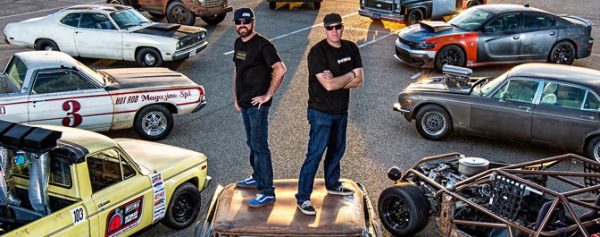
Roadkill is an automotive restoration television show that transforms trashed up beaters into modified road demons. What we love most about this show is creating something so beautiful out of nothing. Coincidentally, it’s the perfect metaphor we see in our students who enroll in our
traffic school online.
The projects seen on the show vary from downright challenging to goofy and absurdly fun. But, don’t you think it’s odd that every project ends on a positive note? It seems almost suspicious. That’s why we’ve done some investigative journalism to pull back the curtains on this popular T.V show. We’re diving deep to discover what really happens to the cars on Roadkill.
[framed_box]
The Ranchero
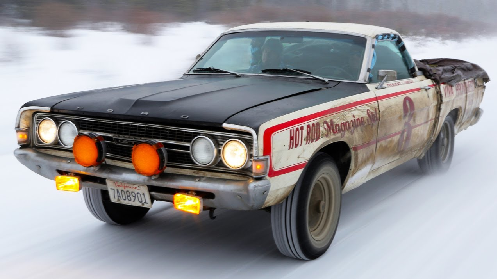
This 1968 Ford Ranchero restoration was a very familiar project for fans of the show. This car’s “notable achievement” was its long journey from Alaska to Los Angeles. But, if you ask us - they might as well call it the 1968 Ford Mentiroso (Spanish for liar.)
But, after doing some research and questioning, we concluded that David Freiburger and Mike Finnegan did, in fact, conduct heavy restoration to the original vehicle. That’s not stopping us from diving deeper!
[/framed_box]
[framed_box]
Big Pen
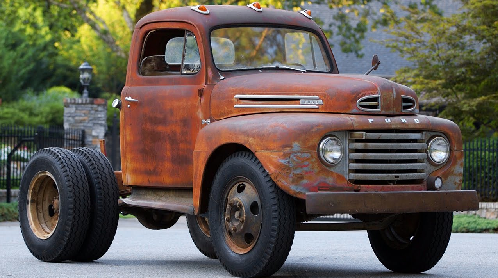
Do you really expect us to believe that they took a broken down 1950 GMC Pick-Up Truck and drove it off the lot, where it sat for 30 years? Likely story, Roadkill. Instead of calling the show Roadkill, they should rename it to Road Fibbers, because that’s all they do to the viewers.
However, again, after a careful examination of the research, we discovered they were able to the beater running. Something still smells off, so the sting story continues!
[/framed_box]
[framed_box]
The General Mayhem
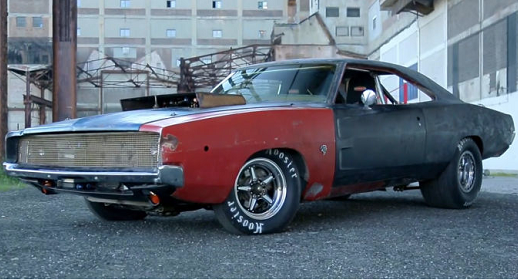
Here is a prime example of what really happens on Roadkill. Freiburger and Finnegan just so happened to be sitting on a ‘68 Dodge Charger, which, was essentially, three pieces of scrap metal attached to wheels. Then, they somehow put a transmission in from a literal motorhome. Supposedly they created it over 6 months - the perfect amount of time to get a brand-new car delivered.
Editor note: after rereading the notes taken during several credible interviews, we have concluded this car was actually restored on the show.
[/framed_box]
[framed_box]
The Blasphemi
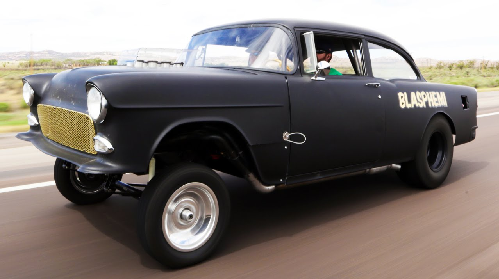
Come on, really? Do they honestly think viewers will believe the hosts brought the bare body of a ‘55 Chevy Bel Air Sedan to a shop and had it restored with a 530ci Mopar Performance Hemi? That idea is - ahem - blasphemy!
Seriously? They did that? That’s so cool! I mean - the search continues to find the real answers.
[/framed_box]
[framed_box]
The Rotsun
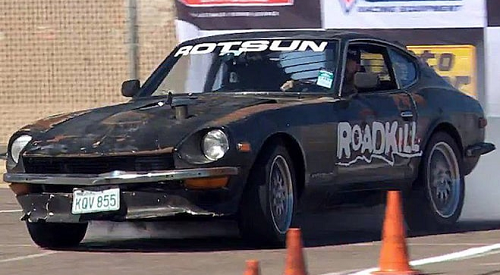
Finally - the truth you’ve all been waiting for! They were given a 1971 Datsun 240Z that was rustier than your little league throwing arm. It was a valiant attempt, but after doing some hard-hitting research we discovered what really happened. After they successfully rebuilt the car to near perfect operating condition, the engine gave out when the hosts drove back from Arizona “after filming.”
There you have it. Nearly all the cars they built on Roadkill continue to work. You can clearly see this is another example of Hollywood Reality TV elites us feeding us fabricated lies.
If you’re ever conducting your own car restoration, and get a ticket for violating a traffic law, you should enroll in traffic school online. It’s the easier way to keep your insurance rate from skyrocketing for being a reckless driver. But, you’ll never be as reckless as the hosts from Roadkill.
[/framed_box]
Jay Leno’s Garage
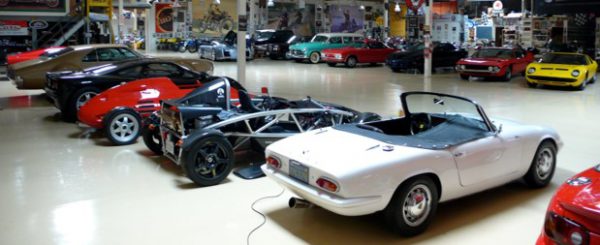
You may recognize the title Jay Leno’s Garage as the popularized television show starring ex-Tonight Show host Jay Leno. Known as a car fanatic, Mr. Leno has a prime collection of automobiles, motorcycles, and other motorized vehicles. This show is all about cars and the car enthusiast.
However, there’s an issue.
As you know, the staff here at Myimprov.com love cars - really anything that has to do with driving. We would’ve loved to indulge in this type of CNBC sophisticated programming. It’s a funny host in a garage full of cars.
But there was something missing.
The show didn’t go deep enough. That’s why I took it upon myself to discover what cars ACTUALLY exist in Jay Leno’s Garage. After hours of meticulous planning, I devised the perfect covert operation to get the full scoop of Mr. Leno’s garage. Here are my findings:
[framed_box]
1970 Mazda Cosmo
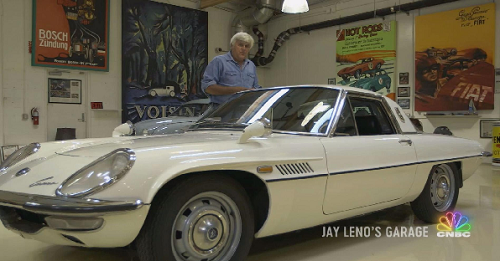
The idea was simple. I arrived at his house dressed as a representative from Mr. Leno’s “Yacht of the Month Club” membership program. I had to scope out his home to discover “the perfect place to drop off his monthly Yacht.”
It worked.
Bingo-bango, I found myself inside of his basement garage. Beholden at the sight of a limited edition 1970 Mazda Cosmo. Sleek in design, pure white like the Mr. Leno’s molar teeth, and - most importantly - fast. I took it for a spin in his underground racing track that he purchased with the residual checks from The Tonight Show.
[/framed_box]
[framed_box]
Audi R8 Spyder
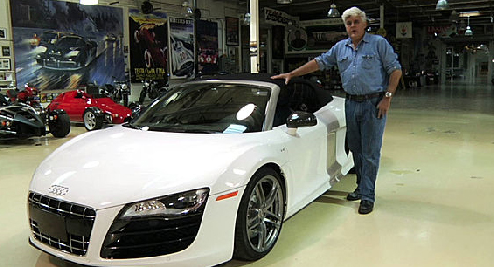
After my joy ride in the Cosmo, I made an appearance upstairs to maintain the charade of me representing the Yacht Club Committee. “It will be any moment now, Mr. Leno,” I told him. He nodded his head begrudgingly.
“Just place it in my 20-mile purchased territory of the Pacific Ocean with the other 20 yachts,” he mumbled as I went back downstairs to his garage. I ignored him. There were cars to explore.
The Audi R8 Spyder caught my eye. It’s known to be among the fastest cars in the world. The desire to sit behind its wheel caused me to salivate. The car was red like fury, compact like a bullet, and worth more than I could fathom. Therefore, I took it for a drive.
[/framed_box]
[framed_box]
Blastolene Special
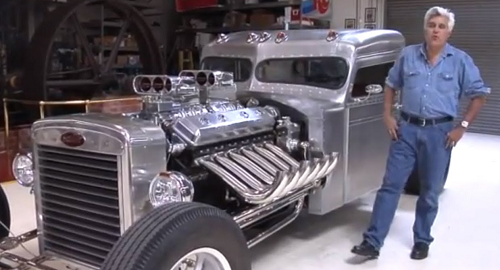
My fun came to a braking halt. Mr. Leno had wandered downstairs with his sailor’s hat and uniform ready to sail on his monthly yacht. The jig was up. He had to stop me, so he did the only thing he could think of in the moment.
He hopped in his Blastolene Special and raced after me. I was awestruck by the beauty of the industrial magnificence that was the Special. Equipped with a supercharged engine, this behemoth of muscle shot towards me at lightning speeds. I didn’t know what would happen if Mr. Leno caught me, but I wasn’t about to find out.
[/framed_box]
[framed_box]
1930 Bentley G400
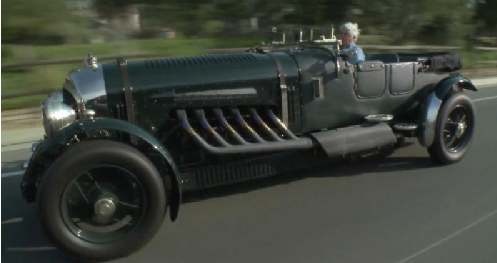
As I was being chased by a very upset Jay Leno, my car enthusiast eye caught a glimpse of a 1930’s Bentley G400. I jumped inside to escape his wrath. Starting the car ignited the WWII plane engine, which was placed inside, and pulsed 700-horsepower through the veins of Bentley’s inner workings.
I escaped Jay by blasting through his garage at lightning speeds. The adrenaline was pumping through my veins, but something was off -- again. The lights of a traffic officer lit up in my rear-view mirror when I pulled onto the 405 North. I was going 20 miles over the speed limit and became a reckless driver.
The officer handed me a ticket for exceeding the speed limit, which will directly affect my annual insurance rates. So, now feels like a good time to let you know something important. When you enroll in
traffic school, you can lower your annual insurance rates. This happens when insurance companies know you’re a safe driver.
I never saw Jay Leno after that night. But, a piece of me wonders if I should return his Bentley…
[/framed_box]
CA Highways and Freeways: What to Expect
I'm sorry, but you didn't provide the text that needs rephrasing. Could you please provide the text so that I can assist you further?
Highways and Freeways are the backbone of the United States’ infrastructure. Between the toll roads and the rest stops you find the American dream in the form of 3-lane paved concrete road. When you’re traveling in California, it’s nearly impossible to get around without cruising the countryside on one of these famous interstate CA highways.
So, what exactly should you expect during your cross-state road trip?
You may find your share of potholes, detours, crazed mountain folk, and road construction when you’re driving up the PCH or navigating through the desert. So, we’re giving you a road map to what to expect from California’s highways and freeways.
[framed_box]
I-5
Interstate-5 is a heavily used north to south highway that stretches across the entire state of California. This freeway directly and indirectly connects every major metropolitan city in the Golden State. Despite being filled with traffic when passing around cities, I-5 is known for its scenic views of central California. Just be sure to watch out for crazed mountain folk! Just kidding - but we’re sure they’re out there.
[/framed_box]
[framed_box]
I-8
Running along Mexico’s border, you’ll see your fair share of sand and dirt. But, that doesn’t stop this interstate from being a breathtaking experience! This freeway is often used for travelers coming or going from San Diego.
On this route, you can pass through the historic town of Yuma on your way to Arizona. Although, the only historical fact about Yuma I know is seeing the film 3:10 to Yuma. You will also pass by the Instagram worthy sand dunes and beautiful sunsets through this desert filled freeway.
[/framed_box]
[framed_box]
I-10
If you’re beach bound coming from Arizona, I-10 is the route for you. You can stay on this highway all the way from Phoenix to Santa Monica. You’ll be so close to the coast, you could practically drive straight onto the beach. Most of this trip is through the desert between the two bordering states, so you can expect flat lands, dried up cacti, and bumpy roads.
If you’re making the drive at night, you can pull over on a side road and look up at the milky way. There’s hardly ever cloud coverage, so you can have a perfect view of the galaxy at night. You don't need fancy scenery when you have the stars!
[/framed_box]
[framed_box]
I-80
Also known as the Dwight D. Eisenhower highway, I-80’s stretch will get you from San Francisco across the country to
New Jersey. You can gain access to this historic highway by entering through the bay area. This concrete path will take you through the countryside of Northern California and well-known landmarks, such as The Central Valley and the Sierra Nevada.
But, be on the lookout for speed limit signs! I-80 has a reduced speed of 65 MPH. Unlike the usual 70 MPH throughout rural California.
[/framed_box]
[framed_box]
“The 101” or “101”
Arguably the most popular highway in all of California. The 101 is among the longest highways in the state. It’ll take you from Oregon to Los Angeles. Along this route, you can expect to find historic landmarks, California staples, the serene countryside beauty, tourist destinations, highway patrol, and even the Golden Gate Bridge.
If you had to sum up all of California into a stretch of road, it’ll be the 101. You can also see the Pacific Ocean along most of this drive, because it runs near the coast.
When you’re cruising through the countryside on a highway or freeway, remember not to speed. We know the temptation can be there. We’ve been down the PCH during sunset. If you ARE slapped with a speeding ticket, remember to enroll in an
online traffic school California. Doing so can wipe away the speeding ticket's points from your driving record, you won’t have to suffer from increased insurance rates, and you can prove to yourself that you are a safe driver. Safe enough for some insurance rate deductions!
[/framed_box]
The Best Time to Drive in California

The tormented know this feeling all too well. You’re jammed in the middle of rows and aisles of cars on a highway you’ve never driven on in California. You had a 1:00PM meeting with the beach, but at this rate, you’ll be lucky to make it there before sundown because of the drive in California. You’ve heard about the monstrous traffic there, but you pushed it away as folklore trying to scare away tourism. Yet, you find yourself stuck in one of the worst traffic jams in the entire country.
Nothing is worse than the helpless feeling you have when you’re imprisoned in a sea of cars. Let’s hope you packed some snacks and used the restroom before you left, because you’ll be stuck on the 101 for another few hours. There’s a light at the end of this traffic jam. Your favorite
online traffic school is here to help. We’re listing the best times to use the roads in California.
[/framed_box]
[framed_box]
Los Angeles
LA has some of the worst traffic in the world. It’s common that a person, leaving from work, can face upwards to 2 hours of traffic on their commute home. That’s horrifying. Unfortunately, it’s life of the Angelino - who owns a car.
Whether you’re driving through Los Angeles or you’re planning on living there, know how to plan around rush hour - or rush 3-hours. The worst times to drive are between 7:00 AM-10:00 AM and again from 4:00 PM-7:00 PM. During these hours, traffic will become more like a nose during the allergy season - it’ll reach max congestion. We joke, but really. Don’t go on the roads between those hours.
[/framed_box]
[framed_box]
San Francisco
San Francisco’s traffic is similar to Los Angeles’ traffic, except everyone wakes up and leaves for work earlier. If you’re navigating the roads through the bay area, be on the lookout of early morning rushers and late afternoon/early evening sleepy commuters. 7:00 AM-9:00 AM and 4:00-6:00 PM tend to be work and home commute rush.
Of course, it tends to be smooth sailing - sorry smooth cruising - when you’re passing through on the weekend. Between Saturday and Sunday, traffic dies down while the rest of San Francisco gets their beauty sleep.
[/framed_box]
[framed_box]
San Diego
Just like most of California, there’s no avoiding the traffic. But, you do have the option of congested traffic or super congested traffic! With that said, if you want to drive through that simple, easy going regular traffic, then try avoiding the dreadful 7:30 AM-10:00 AM and 3:30 PM-6:30 PM.
If you’re visiting San Diego, one of the best options is to travel by foot. It has a vibrant downtown life full of culture, farmers’ markets, and eateries that are all within walking distance.
[/framed_box]
[framed_box]
California State
California is great for vacationing. Especially the Pacific Coast Highway which stretches from north to south along the western coast. So, if you’re planning a family vacation or a romantic getaway to the golden state, you should know the busiest times in the year to get around.
Tourism traffic reaches its high point during the summer season. Visiting the state during Spring, Fall, and Winter will give you plenty of time to visit empty beaches, tourist destinations, and smooth cruises along the coast. Of course, if you want vacant roads, plan to drive on the highways during the holidays. Los Angeles during Thanksgiving looks like a post-apocalyptic waste, except there’s no mayhem and destruction - just no cars on the road.
Remember the best way to drive is by being a defensive driver. Enrolling into a California defensive driving course online with Myimprov.com is will teach you the tools necessary to drive safely. Of course, when you’re stuck in traffic, the only thing to remember is to not yell at the cars around you.
[/framed_box]
2018 Texas Traffic Laws
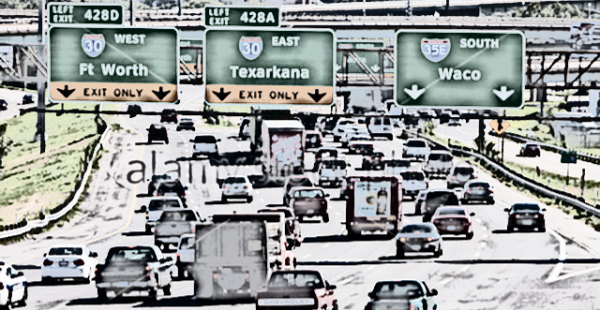
As is the case with most states in the union, Texas is always updating its driving and Texas traffic laws as technology, trends and other factors require it to. For 2018, there are a few notable new laws that have taken effect. We’ll also examine one big notable law that took effect in 2017 that is certainly worth reinforcing when it comes to their significance. Here’s a look:
[framed_box]
Faster Vehicle Sales?
When a vehicle is sold, it’s standard for this ownership to be transferred from seller to buyer. A new bill, S.B. 1062, aims to speed up bill sales by further streamlining odometer readings. Prior to the bill taking effect, the only way to meet the odometer reading requirement for a sale was to do it on a secure form. Why? Because it prevented any tampering from occurring. After it was done this way, the form then had to be mailed, which could potentially delay the vehicle ownership transfer process by a few days.
Now, it’s no longer a requirement to file the odometer reading this way. Per the bill, electronic forms are the only thing that’s needed today, making for faster transfers. It’s also worth noting that electronic readings may also now be submitted in the case of filing an insurance claim. Sometimes, the waiting is the hardest part – this makes the wait times much more manageable.
[/framed_box]
[framed_box]
No Texting and Driving
Though this involves a law that went into effect in 2017, it’s worth repeating.
Texas has joined many other states in the union and has made texting and driving illegal thanks to H.B. 62, which went into effect on September 1, 2017. The statewide ban can result in a misdemeanor offense for those who violate it while operating a vehicle.
According to the law, first-time violators may be fined about $100, with fines doubling for repeat offenders. For context,
Texas speeding ticket cost for going one to 10 miles per hour over the speed limit carries a base fine of $97, while speeding 20 miles per hour or more carries a base fine of $200. (We should also note that if you have tickets and points on your license and are interested in getting your insurance premiums decreased, taking courses at a TX traffic school can help.)
In 2015, almost 3,500 died from an accident involving a distracted driver nationwide. What’s more is that nearly 400,000 people were injured because of distracted driving. It’s these facts that are leading many states to take such matters very seriously, and Texas is now no exception. To date, 47 U.S. states ban texting while driving, as does Puerto Rico, Guam and the U.S. Virgin Islands.
[/framed_box]
[framed_box]
New Weight Limits on Milk Hauling
S.B. 1383 likely doesn’t apply to most Texans, but it’s certainly worth noting when it comes to new driving laws for this year. Specifically, the law has increased the weight limits on the amount of milk that can be hauled in a truck. Prior to 2018, that limit was 80,000 pounds. Now, it’s 90,000 pounds. According to the bill’s sponsor, the last time the milk transportation limits were updated was in 1995, so this was evidently due for a review.
Per the bill, drivers must have a permit to do so. The permit costs $1,200. Again, this won’t apply to the majority of Texas drivers, but we’re guessing that the increased weight limit is welcomed by drivers and grocery stores. For reference, a gallon of milk weighs about 8.6 pounds. That means trucks will be able to carry an additional 1,162.7 gallons with their load.
[/framed_box]
Is Olympic Bobsledding as Dangerous as Speeding?
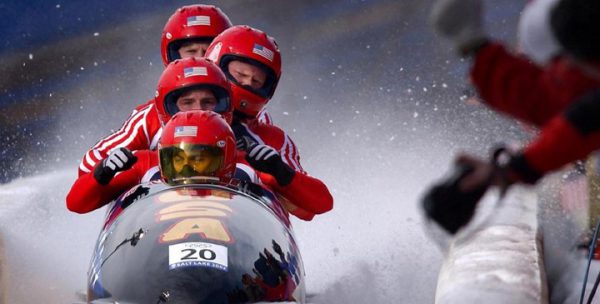
We’ve all had that moment. Sitting at a red light on dry, empty pavement. The road ahead stretched out for miles on end, dissolving over the horizon, beckoning you, seducing you—to slam your foot onto the accelerator and start speeding.
Maybe you’re running late and can’t stand the thought of missing Toyotathon. Maybe you just long to hear the engine roar louder than the wind around you, your vision distorting as your hands clench the wheel and knuckles whiten. The crosswalk timer ticks down as you wait for the light to change. Your heart racing as your lips tremble, then open, and you shakily utter, “Hey Siri, play Danger Zone on Spotify.” Then a split second of inquisition: there’s nothing wrong with a little bit of speeding, right? How dangerous could it be? After all, Olympic bobsledders go really fast. Why can’t I?
[framed_box]
Bobsledding or Speeding?
This is actually a very common question. When approached with this topic, most if not all drivers rationalize speeding in a motor vehicle by comparing it to the bravery and engineering, logistical, and co-ordinational ingenuity of Olympic Bobsledding.
While not logically or morally sound, this is a tactic employed by many decent folks, most of the time just trying to get to where they need to go and finding ways to justify the means of doing so, regardless of the safety of themselves or others.
[/framed_box]
[framed_box]
The Cold, Hard Data
According to the National Highway Traffic Safety Administration (NHTSA), speeding was the cause of 9,557 deaths in 2015. In contrast, there are only a handful of recorded bobsled deaths at Olympic sanctioned events or training exercises. And this is in a sport that involves drivers and riders in thin, aerodynamic body suits and a helmet, hurtling down an unforgiving, serpentine track at over 90 mph in a light metal-bodied sled they can barely see out of.
Even us amateurs with our “airbags” and “seatbelts” operate vehicles at a higher risk of fatality than these brave men and women. Not to mention the risk of injuring or killing someone else at our fault.
[/framed_box]
[framed_box]
The Truth
Setting aside this risk of physical injury or death still leaves us with very little to gain. While an Olympic Bobsledder is paid to represent their country, practice for months and months on end, and stand to win glory, honor, and a priceless medal with some cash, us gas guzzling, rubber tire handling, government safety regulated plebeians stand to win nothing but a few extra minutes wherever we’re going. But more likely, a ticket—or even jail time.
[/framed_box]
[framed_box]
The Solution
It is disrespectful and egregiously offensive to compare our self-conceived prerogative to speed with the prestige of the world’s finest athletes. It is incumbent upon us to yield our most carnal desires; our needs for speeds, to the recognition of the limitation of our abilities.
However, when we fall victim to our self-desires of going over the speed limit and we’re slapped with a traffic ticket, there is a light at the end of the tunnel. That light is Myimprov.com. Your
traffic school online. You don’t have to succumb to increased insurance rates because you have a ticket.
By enrolling into our traffic school online, you can prove to everyone that you are a safe driver. Safe drivers have lower insurance rates and clean driving records. You should stop speeding. But, when you are given a ticket for not controlling yourself, just remember there is a solution.
[/framed_box]
What Happens at a DUI Checkpoint
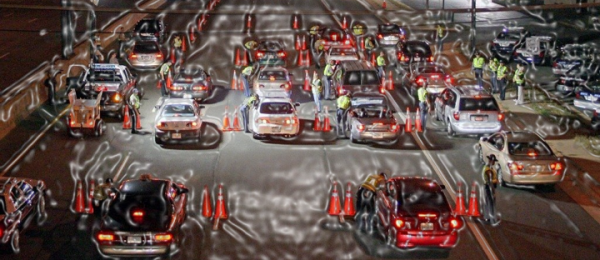
For those curious about the on goings of a DUI checkpoint, we’re exhaling the process of a DUI checkpoint for you. That was an example of some good word play! You didn’t come here for the word play, so here’s what happens during a DUI Checkpoint.
[framed_box]
How They Work
DUI (Driving Under the Influence) or DWI (Driving While Intoxicated) checkpoints can pop up just about anywhere and anytime. You can spot them, because traffic officers create a road block and close off all lanes except for one. This is to check on the status of drivers by filtering them through one, single lane.
The goal is to catch and remove any drivers who may be operating their vehicle under the influence of drugs or alcohol. Therefore, any suspicious behavior is often a sign of someone who is under the influence.
[/framed_box]
[framed_box]
What To Do
Not if, but when you find yourself in the middle of a DUI or DWI checkpoint, the important thing to remember is to comply with traffic police during this process. Creating any kind of confrontation or suspicious behavior is often a red flag. Especially when officers just want to keep the roads safe for everyone.
More often than not, officers ask for your driver’s license and car registration form. Following this, you are asked to briefly answer a series of questions. This will help determine the sobriety of any drivers behind the wheel. Any unusual behavior will encourage the police officers to conduct a field sobriety test.
So, what’s there to expect if you’re expecting a field sobriety test?
[/framed_box]
[framed_box]
Field Sobriety Tests
The Field Sobriety Test is a in depth process to determine the sobriety of the driver. This test is broken into three different physical challenges. But, it’s not like competing in a game show, like how I just described it.
During the first phase of the test, you will be asked to balance yourself on one leg while stretching with the other. If you are under the influence, finding balance will be difficult.
The second step is the notorious walk-in-a-straight-line test. This will challenge your ability to, well, walk in a straight line. Which, when you’re under the influence is extremely challenging to do.
If you’ve made it this far in the test, then get ready for the eye gaze test. This final step tests your ability to follow an object with your eyes while holding your head still. Which, in case you haven’t seen the pattern, is extremely challenging to do while under the influence.
Because it’s designed to be that way.
These tests have been tested to be accurate, since they are standard across the country. So, forget about trying to learn the alphabet backwards, because that’s a sobriety test that nobody can pass. Not even people who are sober.
When you find yourself stuck in a DUI checkpoint, just remember that the traffic officers are keeping the roads safe. You should always comply and make their job easier, because nobody enjoys dealing with difficult people. Finally, never operate a vehicle while under the influence.
If you know someone who is a first time Nevada DUI offender, they will be required to take a
NV 8 hour DUI course. Other states may order offenders to take
traffic school to lessen the charges.
Keep a clean driving record and never get sloppy behind the wheel!
[/framed_box]
Safe Driving Behind All Types of Wheels
Driving has become something that we more or less take for granted. It is a habit that we have developed to help us with our daily lives. Whether it be taking the kids to and from school or going to work, driving should be viewed as one of our most prized privileges. For any of you who have ever lost your driving privileges, you know how difficult it can be to get to where you need to go.
There are many ways to lose your driving privileges, but there are also many avenues for keeping them. For example, one of the best things you can do to learn about the various ways to maintain your driving privileges is by taking part in an
online traffic school California permit class. Also, if you have acquired a traffic violation, you should consider going to traffic school so that the violation does not stay on your driving record. For now, let's take a look at the
oilfield and how traffic violations play a huge part in oilfield fatalities.
[framed_box]
What Do You Think About It?
Did you know that thinking while you are driving can actually be a problem when your thoughts are focused on something either than properly driving your car? When you aren't focused on the things going on around you, such as the speed of the cars in front of you or whether you have fastened your seatbelt, this greatly increases your odds of being involved in an accident and getting injured. In fact, speed and seatbelt use just so happen to be the two largest contributing factors to oil-field related deaths. One might think that getting hurt on the rig might be the number one contributor, but it isn't.
[framed_box]
A Closer Look at the Data
The decade that took place between 2003 and 2013 was one that saw unprecedented growth in the oil and gas extraction industry. The size of the workforce doubled and saw an increase of 71 percent in the number of rigs being drilled. The CDC analyzed data relating to fatal occupational injuries in this industry and found that more than 33 percent of worker fatalities in the oil and gas extraction industry were caused by transportation incidents.
When looking at the details involved in these accidents, it is clear to see that there is a lack of attention contributing to the fatalities, such as speeding down the road at 70+ mph and not slowing down when getting close to town and the speed limit lowers to 35-45 mph. Data shows that the biggest contributors to these accidents are not related to road or weather conditions. Instead, they are driver-behavior related:
• Failure to control speed
• Lane change-passing
• Driver fatigue
• Driver inattention
• Faulty evasive action
[/framed_box]
[framed_box]
What Action Is Being Taken?
Fortunately, these data points and statistics are leading to positive action being taken by a variety of coalitions, including the Permian Road Safety Coalition, which is working in conjunction with the Texas Department of Transportation, as well as with other industry experts, to assess the causes of fatalities and properly address them.
For example, they have studied why drivers still after all these years are failing to wear their seatbelts. The truth is, though, this action is simply a bad habit. Oilfield workers get in and out of their vehicles numerous times throughout the day, making it a nuisance to many of them to put on and take off their seatbelt. This type of bad habit must be altered, and thankfully, a simple in-the-truck reminder is all it takes to get drivers to start wearing their seatbelts. Such reminders can come through an In-Vehicle-Monitoring Solutions (IVMS) program.
[/framed_box]
[framed_box]
What Is an IVMS Program?
This type of program is becoming more popular because it helps companies curb recordable driving incidents. The system will provide immediate feedback to drivers when they are taking part in one or more activities that put them at risk for an accident or injury, such as not wearing their seatbelt or speeding.
[/framed_box]
[framed_box]
The Conclusion
It is important to note that new workers to the oilfield have a greater chance of being involved in an accident because of a lack of experience in driving in the oil patch, as well as inexperience in driving industry-specific equipment. This is why it is all the more important for fleet vehicles to be properly monitored with an IVMS.
[/framed_box]
Checking Your Credit Score Before Buying a Car
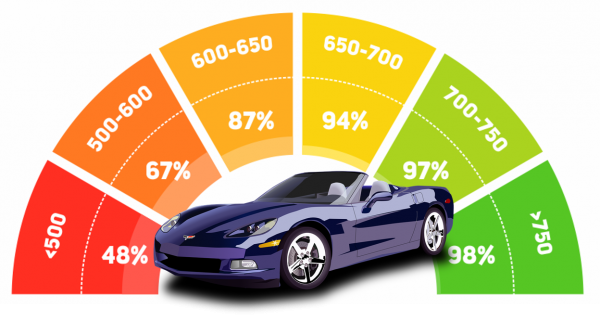
Before you begin to shop around for an auto loan to buy a car, it is an excellent idea that you start by knowing what is in your credit report. Doing so not only helps you to access the right financing but can also save you thousands of dollars’ worth of loan interest if you take your time to improve your credit score. Additionally, you might also be eligible for an auto insurance discount if you have completed a
NYS defensive driving course as explained below.
[framed_box]
Why Check Your Credit Score Before Buying a Car?
There are two significant reasons why you should check your credit score before buying a car. Firstly, your credit score influences the willingness of lenders to finance your auto purchase. You can think of it as a measure of your trustworthiness to your loan financiers based on your previous debts and payments history. Secondly, although you may get an auto loan with a very low credit score, your interest rates will be much higher. Therefore, knowing your credit score in advance gives you time to improve your rating and thus avoid paying very high interest rates on your auto loan. Remember, lowering your interest rate even by a small percentage loan’s lifespan.
[/framed_box]
[framed_box]
Does Your Credit Score Drop Every Time You Have It Checked? Myth or Real?
It is important to know that not all searches into your credit score cause it to drop. Instead, the primary determining factor is whether you are placing a hard or soft inquiry. As per the Fair Credit Reporting Act, the reason for accessing your credit score and the person pulling it are the two major factors that determine if the inquiry is hard or soft as explained below.
• Hard inquiry: Occurs if your business or lender obtains your credit report following an application for a loan or credit. Every hard inquiry reflects on your credit report and will, therefore, drop your score.
• Soft inquiry: Results if you or a lender obtains your credit score report to serve as a background check without necessarily applying for the loan. For instance, if you want to get a quote for your auto loan, the lender will do a soft search, and doing so will not affect your credit score.
Additionally, you can personally check your credit rating as many times as necessary because it would only amount to a soft inquiry that cannot hurt your score in any way.
[/framed_box]
[framed_box]
Why You Need a NYS Defensive Driving Course Certification
Insurance companies usually provide discounts to drivers who actively sharpen their driving skills and take steps that encourage safe driving behaviors. With safer driving, insurance companies receive fewer claims, which is the reason they can afford to offer you a discount if you have completed a defensive driving course. The certification usually covers the following aspects:
• Traffic laws
• Alcohol and drug awareness
• Defensive driving techniques
• Driving in adverse weather
• And more
Most insurance providers grant a defensive driving discount only one car and you should have completed the course with a passing grade to earn it.
[/framed_box]
[framed_box]
Final Thoughts:
Ensure that you have a defensive driving certification before buying a car because you can it to negotiate an insurance discount that will go a long way in keeping your premiums as low as possible. Additionally, let different car dealers access your credit score only to quote their interest rates for your auto loan. This way, you avoid hurting your credit score with hard inquiries that come with applying for a car loan which you are not sure you can qualify.
[/framed_box]
Unknown Cheap Vacations in California
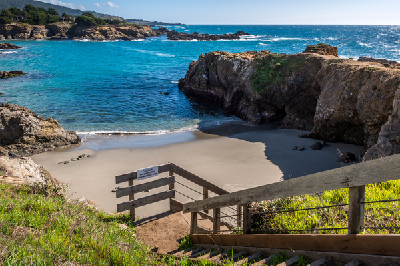
Since you passed
traffic school, your expensive traffic ticket received a price reduction. Now you can use all the money you saved to treat yourself to something nice - like one or two cheap vacations in California.
We’re helping you escape your busy city life or your mundane town, so you can explore somewhere unfamiliar. Here’s a list of unknown, cheap California vacation spots you might not know exist.
[framed_box]
Sea Ranch
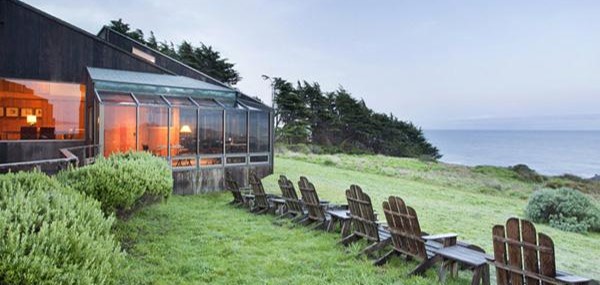
Located 110 miles north of San Francisco, Sea Ranch is an architect’s playground. This stretch of land is known for its creative, artistic houses surrounded by the beauty of northern California. Architects have poured their creative souls into building small houses that are used by locals of the area.
You can rent one of these homes for a weekend getaway. It's a simple and creative way to spend your cheap vacation. You’ll be secluded in the hills and mountains, away from the bustling lifestyle of city living.
[/framed_box]
[framed_box]
Big and Little Petroglyph Canyon

If you’re a fan of art and history, then Big and Little Petroglyph Canyon could be a vacation you’d enjoy. Preserved on these landforms are old Native American Petroglyphs. Created by the Coso people, some of the paintings are estimated to be 10,000 years old.
This area is a great hiking spot that will take you through the history and culture of the canyon. You can also post up camp on government owned grounds nearby for a wilderness adventure on a budget. But, if you want to visit a town, nearby are Ridgecrest and China Lake.
[/framed_box]
[framed_box]
Drakesbad
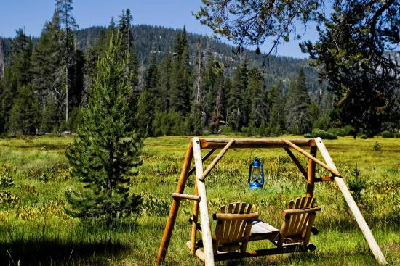
Explore a village locked in time. Drakesbad is a fun vacation spot that offers outdoor activities and lodging. This location is great for entire families and for couples. Horseback riding, archery, massages, and more can be had while visiting this village pushed away in a volcanic national park.
Drakesbad has a reputation for helping you unplug from life and disconnecting from stressors of your day-to-day. You can explore flowery meadows, culinary creations, and beautiful nights under the stars in this small village. It also has cabins and other lodgings that will meet the needs of any sized party.
[/framed_box]
[framed_box]
Mammoth Lake Hot Springs
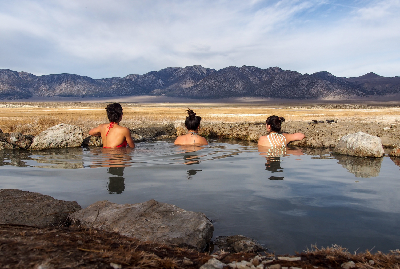
If you’re on a budget, no problem. You can still get that relaxing jacuzzi experience you would find at that high-end resort you’ve always wanted to visit. All you have to do is travel to Mammoth Lake Hot Springs. The hot springs are like jacuzzies, but they’re naturally formed by volcanoes erupting thousands of years ago.
Soak up the warmth by visiting these natural springs. Located north of Bishop, California, this area is teeming with relaxation. You can find a cabin for the weekend or rent out a house. If you don’t like looking at nature, you can always close your eyes and pretend you’re on that Malibu resort you couldn’t afford.
[/framed_box]
[framed_box]
Murphys
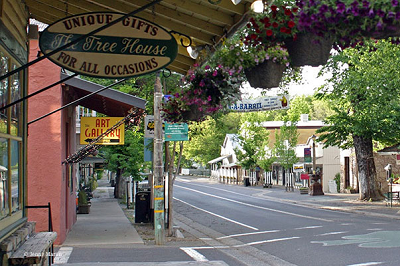
When in doubt, you can wine it out. If none of these vacation ideas appeals to you, then visit Murphys, California. This small town experienced a sudden population boom, and, from there, built out a very diverse community of wineries.
Murphys is built with stone wall buildings, surrounded by beautiful nature, and is in abundance of boozy wines. You can spend your cheap vacation drinking wine in California’s great northern wine town. But, if you don’t want to spend the entirety of the vacation drinking wine, there are natural redwood parks and caverns that are ready to be explored nearby.
[/framed_box]
California has lots of hidden gems and secret vacation hot spots. Whether you’re camping or tasting wine, you can find anything you’re looking for - and on the cheap too. So, take that extra money you saved and put it towards your very own inexpensive vacation.
The Best & Worst CA Airports
I'm sorry, but it seems like the instructions provided are incomplete or malformed, making it difficult to rephrase the text accurately. Could you please provide the entire text that needs rephrasing?
The traffic doesn’t end on the roads in California. The Golden State has one of the busiest air ways in the entire country. With some of the most populated cities in the nation and vast amount of state territory, California is a must stop destination for tourist, travelers, and people seeking gold. Although the last one might be a few hundred years too late.
The airports can be daunting, if you don’t know anything about them. That’s why we’re getting off the roads and into the sky to tell you about the best and worst airports in California.
[framed_box]
Los Angeles International (LAX)
LAX is the most popular airport in California and the second most popular airport in the country, Los Angeles International airport is consistently booked with incoming and outgoing passengers. It’s also known for its construction zones, bustling traffic, and pricey foods.
Things can get chaotic here. So, if you want to avoid flying into a busy airport, then LAX might be a bad option.
[/framed_box]
[framed_box]
San Francisco International (SFO)
Located south of downtown San Francisco, the San Francisco International airport is the busiest airport in northern California. This airport has its share of art installations and visual appeal. It’s also home to its very own museum that was established in 1980.
SFO is a moderately busy in relation to LAX, but it doesn’t have the same reputation as its southern counterpart. San Francisco International, when prepared, will be a breeze to navigate for any airway passenger.
[/framed_box]
[framed_box]
John Wayne Airport (SNA)
If you need to touch base near the Disneyland Resort, John Way Airport is your ticket. This is LAX’s smaller neighbor who receives around 9 million passengers a year.
It’s busy, but it’s not that busy.
If you fly into this airport, you’ll also get to see the statue of John Wayne himself greeting you on a safe landing.
[/framed_box]
[framed_box]
San Diego International (SAN)
San Diego International airport is a great destination for anyone who wants to visit California’s southern border. Its clean and open airport is a great place to fly in for large parties and individual passengers.
One fact you might not know about this airport is the sectioned nesting ground for endangered species. Also, San Diego International airport was ranked #2 in best airports in the world.
[/framed_box]
[framed_box]
San Jose International (SJC)
San Jose is the largest city in the Bay Area, but San Jose International is the smallest airport in the area. Compared to others, San Jose International has received the fewest accidents in the past 30 years.
It’s a safe landing, take off, and it’s a smaller airport. If you’re traveling to San Jose, then consider taking SJC.
[/framed_box]
[framed_box]
Sacramento International (SMF)
Ah, yes! The capital city of California. SMF is the international airport for this metropolitan area. Known for its cleanliness and sleek design, the Sacramento International airport is a sight to admire.
You won’t have any problems navigating through SMF. As long as you have all your traveling documentation and your luggage is light, passing through Sacramento will be a fun, casual experience.
[/framed_box]
[framed_box]
Vandenberg Air Force Base (VBG)
The Vandenberg Air Force Base is a fantastic airport. You’ll see local flights, international flights, and… outer planetary flights.
Actually, it’s a space and missile testing base with the goal of placing satellites into polar orbit. It’s not open for commercial passengers, but it is a great airport, because it’s Air Force owned and operated. So, unless you’re a long-range ballistic missile, maybe consider flying into somewhere else.
[/framed_box]
[framed_box]
Hollywood Burbank Airport (BUR)
Did you know that Hollywood and Burbank have their own airport? Neither did we! If you’re aiming to fly into an area for a quick film pitch before your noon lunch, then the Hollywood-Burbank Airport is your destination.
Located north of Downtown Los Angeles, BUR is light on air traffic, because it’s also a local flight only airport. All the big airliners are flying into LAX.
But, if flying isn’t an option and you’re afraid of receiving a traffic ticket when you drive, just remember that Myimprov.com has your back. We have the best
traffic school online California has to offer.
[/framed_box]
If you enroll in a defensive driving course, you can lower the price of annoying tickets that you accumulate from not flying to your next destination.


 Live Chat