


How many points can suspend a NY license?
Under current NY DMV rules, accumulating 11 or more
points within any 18-month period may result in license suspension.
Always verify at dmv.ny.gov as rules are subject to change.
How do I reduce points on my NY license?
Completing a DMV-approved Point and Insurance Reduction Program
(PIRP) course subtracts up to 4 active points from your record for
suspension calculation purposes and earns a mandatory 10% insurance premium
discount for 3 years.
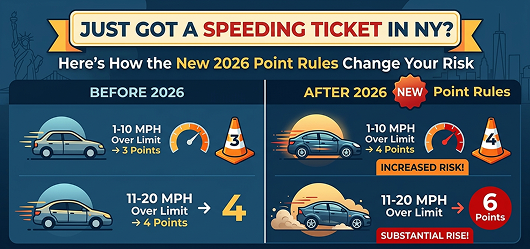
A speeding ticket in New York has always carried consequences. But in 2026, the NY DMV updated its point system,
introducing new point values for several serious violations and expanding the categories of offenses that carry
points at all.
The result is a system where the same driving behavior can now generate higher point totals than it did in previous
years. If you received a speeding ticket in 2026, the rules around what happens next are different from what you may
remember. This guide covers exactly what changed, what your ticket actually costs you, and what you can do right now
to protect your license and reduce the financial impact.
For a full breakdown of how the PIRP insurance discount works alongside point reduction on your NY license, see
IMPROV’s dedicated resources.
How the NY DMV Point System Works
The New York State Driver Violation Point System tracks unsafe driving behavior and identifies drivers whose
records indicate a pattern of risk. When you are convicted of a qualifying moving violation, the DMV assigns a set
number of points based on the type and severity of the offense.
Key takeaway
Points are tied to the date of the violation, not the date of your court
conviction. That means the DMV clock starts the moment the offense occurred, regardless of how long your case
takes to resolve in court.
Current Suspension Threshold
Under current NY DMV rules, accumulating 11 or more points within any 18-month
period may result in license suspension. Verify the current threshold directly at dmv.ny.gov, as rules
can be updated.
What Changed in 2026
The NY DMV updated its point schedule in February 2026, with new values taking effect on February 16, 2026. Many
everyday violations point to assignments remaining unchanged. What shifted is the point value for some of the most
serious offenses, and the addition of points for categories that previously carried none.
Why This Matters
A driver who received certain violations before February 16, 2026, may have been in a very different position than
a driver who received the same violation one day later. The table below reflects the current confirmed values from
the official NY DMV website.
Here is what the NY DMV point system now reflects for the most significantly updated categories:
- DWI, DWAI, Aggravated DWI, DWAI Drugs: 11 points. This category now carries the maximum point
value the system assigns. - Speeding in a construction zone: 8 points, regardless of how far over the limit the driver was
traveling. - Passing a stopped school bus: 8 points.
- Over-height vehicle violations: 8 points. Previously carried no points.
- Aggravated Unlicensed Operation (AUO): listed in the NY DMV point table at 11 points. Note that
AUO under VTL 511 is primarily a criminal offense and may carry severe penalties that go beyond the standard point
system. Consult a traffic attorney if you are facing this charge.
Accuracy Note: Third-Party Sources
- Some third-party sources report the suspension threshold as ’10 points in
24 months.’ The official NY DMV website currently states the threshold as 11 points within 18 months. Always check dmv.ny.gov directly before making decisions based on your point total.
Current Point Values: Full Reference Table
The following values are sourced directly from the official NY DMV Driver Violation Point System page. Use this
table to calculate your current exposure after a violation.
| Violation | Points |
|---|---|
| Speeding 1 to 10 mph over the limit | 3 |
| Speeding 11 to 20 mph over the limit | 4 |
| Speeding 21 to 30 mph over the limit | 6 |
| Speeding 31 to 40 mph over the limit | 8 |
| Speeding more than 40 mph over the limit | 11 |
| Speeding in a construction zone | 8 |
| Reckless driving | 5 |
| Mobile phone / portable electronic device use | 5 |
| Passing a stopped school bus | 8 |
| Failed to yield right of way | 3 |
| Red light or stop sign violation | 3 |
| Improper passing or unsafe lane change | 3 |
| DWI / DWAI / Aggravated DWI / DWAI Drugs | 11 |
| Most other moving violations | 2 |
Source: NY DMV Driver Violation Point System (dmv.ny.gov), confirmed February 2026.
What a Speeding Ticket Actually Costs You
The fine on your citation is only one part of what a speeding conviction costs. There are three separate financial
consequences to account for.
The Fine
NY speeding fines vary by speed and court. For speeds under 10 mph over the limit, fines typically start around
$133 before mandatory surcharges. Higher speeds carry proportionally higher base fines.
The Driver Responsibility Assessment
Once you accumulate 6 or more points within 18 months, the DMV bills a Driver Responsibility Assessment separately
from any court fines. Failure to pay it results in an additional license suspension.
| Points in 18 Months | Annual Fee | 3-Year Total |
|---|---|---|
| 6 points | $100/yr | $300 |
| 7 points | $125/yr | $375 |
| 8 points | $150/yr | $450 |
| 9 points | $175/yr | $525 |
| 10 points | $200/yr | $600 |
| DWI conviction (separate) | $250/yr | $750 |
Why this matters
A single speeding conviction for 31 to 40 mph over the limit carries 8
points. On an otherwise clean record, that one ticket triggers the DRA fee ($150 per year, $450 total) and leaves
you only 3 points away from a possible suspension.
The Insurance Increase
Your insurer receives a report of every conviction and may surcharge your premium at renewal. The amount varies by
carrier and violation severity. A single speeding ticket at 15 mph or less over the limit on an otherwise clean
36-month record may not trigger a rate increase by law. Higher speeds or multiple violations typically will.
Best Practices: Assessing Your Full Exposure After a Ticket
- Check your current point total by requesting your driving record through the NY
DMV MyDMV portal before taking any action. - Add the new violation’s points to your existing total to see where you stand relative to the 11-point threshold.
- Calculate whether 6 or more total points fall within the same 18-month
window to determine whether a DRA fee applies. - Check your insurance renewal date so you know when a potential surcharge
may take effect. - Respond within the deadline on your citation, even if only to plead not guilty and request a hearing.
Three Violations That Now Carry 8 or More Points
Speeding in a Construction Zone
Construction zone speeding now carries a flat 8 points regardless of speed over the posted limit.
Previously, point values in construction zones followed the standard speeding schedule.
Why this matters
A driver who already has 3 points on their record and receives a
construction zone speeding ticket adds 8 more, bringing the total to 11 — the suspension
threshold — in a single additional ticket.
Passing a Stopped School Bus
This violation now carries 8 points. A single school bus conviction on an otherwise clean record
is enough to trigger the DRA fee (at 6 points) and place a driver within 3 points of the suspension threshold.
DWI and Alcohol-Related Convictions
DWI, DWAI, and Aggravated DWI convictions now carry 11 points, the maximum single point value the
system assigns. An 11-point conviction on an otherwise clean record places the driver at the threshold immediately.
These convictions also trigger a separate mandatory DRA fee of $250 per year for three years ($750
total) that applies specifically to alcohol-related driving incidents, in addition to any points-based
DRA.
Best Practices: Handling High-Point Violations
- For any violation carrying 6 or more points, consult a traffic attorney before deciding to pay, fight, or accept a plea.
- Outside the NYC Traffic Violations Bureau, many courts offer reduced
charges on first offenses, but this requires active negotiation. - For DWI charges, DMV consequences are entirely separate from court
outcomes. A reduced court charge can still trigger full DMV point penalties. - Complete a DMV-approved defensive driving course to reduce up to 4 active points after a high-point conviction, subject to the 18-month eligibility window.
The PIRP Course: Your Primary Tool for Reducing Points
How does the PIRP course work in New York?
Completing a NY DMV-approved PIRP course subtracts up to 4
active points from your driving record for suspension calculation purposes. It also earns a mandatory
10% reduction on your liability, no-fault, and collision insurance premiums
for 3 years under NY Insurance Law Section 2336.
The NY DMV point system explained makes clear that completing the PIRP course is the primary active tool available
to drivers for reducing their point total without going back to court. Here is exactly what it does and does not do:
- Subtract up to 4 active points for suspension calculation purposes.
- Apply to points from violations within the 18 months before your course completion date.
- Earn a mandatory 10% insurance premium reduction for 3 years, from every licensed NY
insurer.
- Remove the underlying violation or conviction from your driving record.
- Prevent mandatory suspensions for DWI, DWAI, or other offenses with their own administrative actions.
- Reduce any DRA fees already owed to the DMV.
Key takeaway
A driver sitting at 9 points after a speeding conviction who completes the
PIRP course drops to 5 points for suspension calculation purposes. That moves them from being 2
points away from a possible suspension to having a 6-point buffer.
Course Eligibility and Timing
The PIRP point reduction is available once every 18 months. The insurance discount renews
independently every 3 years. You do not need a ticket to take the course. Many NY drivers complete it proactively to
build a buffer and lock in three years of savings before any violation occurs.
How to Respond to a Speeding Ticket Under the Current Rules
Option 1: Pay the Fine
Paying is the fastest resolution. Appropriate when the violation is minor, your record is clean, and you are well
below the suspension threshold. Paying is an admission of guilt and the points will appear on your record.
Option 2: Contest the Ticket
Pleading not guilty and requesting a hearing keeps your options open. Within New York City’s five boroughs this is
handled by the Traffic Violations Bureau. Outside the city, you appear before the local court on your citation. An
attorney can negotiate reduced charges in courts where plea bargaining is available (not permitted in the TVB).
Option 3: Complete the PIRP Course
This is not a substitute for responding to your ticket. It is an additional step that reduces your point exposure
and earns the insurance discount regardless of the ticket’s outcome. Many drivers do both: respond to the ticket and
complete the PIRP course.
Best Practices: After Receiving a Speeding Ticket in NY
- Respond within the deadline on your citation (typically 15 days). Ignoring
it results in a default conviction and license suspension for failure to pay. - Check your current point total before deciding whether to pay or fight. The higher your existing points, the
more important this ticket’s outcome becomes. - For violations carrying 6 or more points, consider hiring a traffic attorney. The cost is often justified by the reduction in DRA fees and
insurance surcharges. - Complete the PIRP course within the 18-month window of your violation to
apply the 4-point reduction to your current exposure. - Submit your PIRP certificate to your insurer within 90 days of completion
to activate the retroactive 10% premium reduction.
Why the Insurance Discount Matters More After a Conviction
After a speeding conviction, your insurer may apply a surcharge to your premium at renewal. The PIRP course’s
mandatory 10% base rate reduction does not cancel that surcharge. The two operate independently.
On a $4,095 average annual NY full-coverage policy, the 10% base rate reduction saves
approximately $409 per year, or $1,227 over the full 3-year discount period. That
return applies whether you take the course proactively or in response to a violation.
Key takeaway
If your insurer applies a surcharge for a conviction, the PIRP discount still reduces your
base rate. The two adjustments sit on your policy independently. For a full breakdown of how PIRP works in New
York and how to submit your certificate, visit IMPROV’s NY car insurance discount page.
Checking Your Driving Record
Before making any decision about how to respond to a ticket, knowing your exact current point total is essential.
Request a standard driver record abstract through the NY DMV MyDMV portal online.
The standard abstract shows current violations and points, any suspensions or revocations, most traffic convictions
from the past 3 to 4 years, and accidents on file.
Why This Matters
Points no longer count toward the suspension threshold once 18 months have
passed from the violation date, but they remain visible on your record and may still be used by your insurance
company in premium calculations for up to 5 years.
Best Practices: Keeping Your NY License Clean Going Forward
- Request a copy of your driving record at least once a year to verify your
point total and catch any errors. - Complete the PIRP course proactively before reaching a point total that
puts you at risk. It is available to any NY-licensed driver at any time, with or without an active ticket. - Renew the insurance discount every 3 years by retaking the course. The
point reduction benefit is available separately every 18 months. - If you receive a suspension notice from the DMV, respond immediately.
Driving on a suspended license is a criminal offense under NY VTL Section
511 and can carry fines, additional suspensions, and potential criminal charges. - If your point total is approaching the threshold, consult a traffic
attorney before any additional violations are processed.