


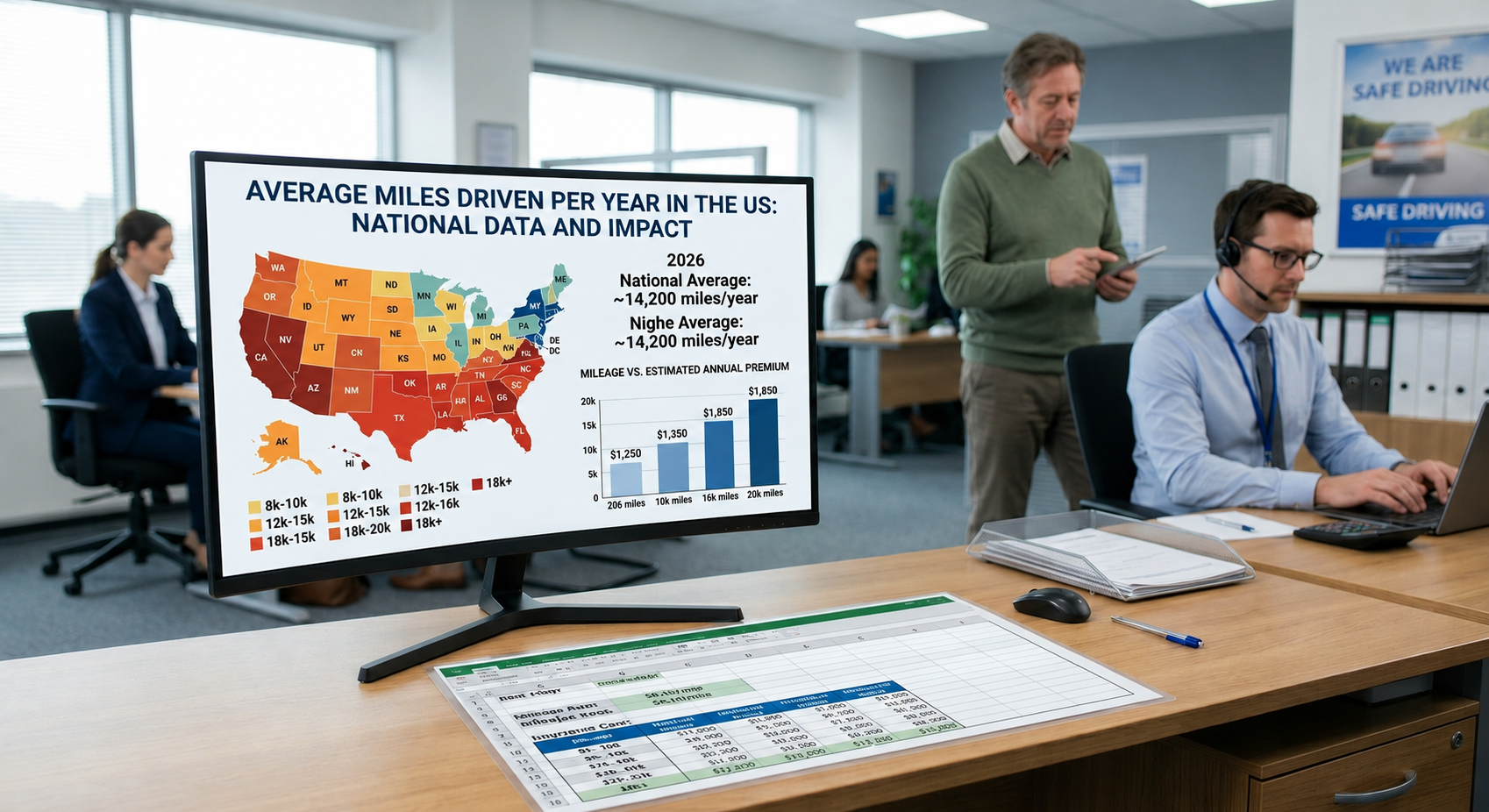
Most drivers have no idea how many miles they put on their car each year. They just drive. Work, school, groceries, weekends, repeat. The number adds up quietly in the background, and by the time it shows up in your insurance premium, it is already too late to do much about it.
The average miles driven per year in the US is 13,700, based on the most recent Federal Highway Administration data. That figure sounds manageable until you realize a driver commuting 35 miles each way can hit that number before the year is even three-quarters over. For a lot of Americans, 13,700 is not a ceiling. It is a floor.
Taking a defensive driving course is one of the more straightforward ways to push back against what high annual mileage does to your premium. But first, it helps to understand what the numbers actually look like and why insurers care so much about them.
How many miles does the average American drive per year?
The Federal Highway Administration puts the confirmed per-driver average at 13,700 miles for 2023, the most recent figure available. Broken down, that is roughly 1,133 miles per month and about 37 miles per day. FHWA’s Spring 2025 forecast projects total vehicle miles traveled growing at 0.6 percent annually through 2053, so the per-driver number is edging upward year over year.
- National average: 13,700 miles per year (FHWA, 2023)
- Monthly breakdown: approximately 1,133 miles
- Daily breakdown: approximately 37 miles
- Men average: 16,550 miles per year
- Women average: 10,142 miles per year
US Driving Mileage Statistics Explained
The National Average in Real Terms
The Federal Highway Administration’s annual vehicle miles traveled data is the standard reference most insurers, researchers, and transportation planners use. The 2024 per-driver breakdown has not yet been publicly released, so 13,700 miles remains the most defensible published figure for 2026.
What does 13,700 miles actually look like? Roughly the distance from New York City to Los Angeles and back, with a few hundred miles left over. It sounds like a lot on paper. But once you factor in a daily commute, weekend errands, school pickups, and the occasional longer trip, it starts making sense very quickly. Most people who track their driving for the first time are surprised by how fast it climbs.
Annual Mileage by Month, Day, and Driver Type
The math works out to about 1,133 miles per month or 37 miles per day. For a five-day commuter, that is roughly 14 to 15 miles each way before adding anything else.
Worth knowing: not all drivers are anywhere near the average. Someone working from home looks completely different on a mileage basis than someone driving to client sites five days a week.
| Annual Mileage | Risk Category | Typical Premium Impact |
|---|---|---|
| Under 7,500 miles | Low mileage | Discount eligible at most carriers |
| 7,500 to 12,000 miles | Below average | Standard or slightly favorable rate |
| 12,000 to 15,000 miles | Near average | Standard rate |
| 15,000 to 20,000 miles | Above average | Moderate surcharge |
| Over 20,000 miles | High mileage | Elevated underwriting risk |
Urban drivers with decent transit options usually fall in the lower bands. Suburban and rural drivers who depend entirely on their cars regularly exceed the national average without giving it a second thought.
How Male and Female Drivers Compare?
Men average 16,550 miles per year. Women average 10,142. That is a meaningful gap, and researchers generally attribute it to commuting habits, work travel patterns, and how people use their vehicles day to day. Neither number says anything about driving ability. It just reflects how differently two groups tend to use the same tool.
Is 20,000 Miles Per Year a Lot?
By most standards, yes. Twenty thousand miles is nearly 50 percent above the national average. Drivers in that range tend to be long-distance commuters, rideshare or delivery drivers, real estate agents, field reps, or anyone whose job puts them on the road for hours at a stretch.
From an insurance standpoint, 20,000 annual miles plants you firmly in an elevated risk category. It does not necessarily mean your premium becomes unmanageable, but the underwriting calculation is working against you in ways it simply is not for a driver who clocks 9,000 miles a year. Knowing what tools exist to push back on that is worth understanding before your next renewal letter arrives.
Why Mileage Shows Up in Your Insurance Bill?
The Basic Logic
Picture two drivers. One commutes 45 minutes each way, five days a week, plus weekend errands. The other works from home and drives maybe twice a week. Same neighborhood, same car, same clean record. Who is more likely to be in an accident by the end of the year?
The one spending two hours a day behind the wheel, obviously. More time on the road means more exposure to the conditions where things go wrong. That is not a judgment on skill. It is just probability, and insurers price on probability.
Most standard auto policies use declared annual mileage as a rating factor from day one. You estimate how much you drive when you apply, and that number feeds directly into your base premium. Significantly underreporting that mileage is not a great idea either. If a discrepancy comes up during a claim review, it can complicate the process.
What the Mileage Bands Actually Mean for Your Rate?
| Annual Mileage | Risk Category | Typical Premium Impact |
|---|---|---|
| Under 7,500 miles | Low mileage | Discount eligible at most carriers |
| 7,500 to 12,000 miles | Below average | Standard or slightly favorable rate |
| 12,000 to 15,000 miles | Near average | Standard rate |
| 15,000 to 20,000 miles | Above average | Moderate surcharge |
| Over 20,000 miles | High mileage | Elevated underwriting risk |
These are general guidelines. Actual impact varies by carrier, state, vehicle type, and everything else on your record. But the direction is consistent across the board: more miles, higher rate.
Pay-Per-Mile Programs and Why They Help Some Drivers but Not Others
Several major carriers now offer usage-based or pay-per-mile programs. The pitch is appealing: drive less, pay less. For drivers well below the average miles driven per year, these programs can deliver real savings.
For high-mileage drivers? Not so much. The entire reward structure is built around low use. If you are putting on 20,000 miles a year because your job requires it, a mileage-tracking app is not going to help your premium. It might actually confirm the elevated rate the insurer already had in mind. There are better tools for that situation.
What High-Mileage Drivers Can Actually Do About Their Premium?
Here is the honest version: for most people, driving less is not a realistic option. You cannot shrink a 40-mile round trip without moving or changing jobs. The commute is what it is.
So the more useful question is whether there is a way to reduce the base rate without changing your behavior. In New York, there is.
Completing a DMV-approved PIRP course triggers a mandatory 10 percent reduction in your liability and collision premiums for three full years under New York Insurance Law section 2336. Not a discount some carriers offer and others do not. Not a promotional rate. A legal requirement. Every insurer licensed in New York must apply it after you submit a valid certificate.
That reduction does not care how many miles you drive. A high-mileage driver and a low-mileage driver get the same 10 percent off their base rate. For someone paying $3,500 a year in premiums, that is $350 back annually and over $1,000 across the three-year window. The course itself takes a minimum of 5.5 hours, is completed entirely online, and the savings kick in at your next renewal.
If telematics programs work against high-mileage drivers and there is no practical way to reduce the annual number, a defensive driving discount is one of the few remaining levers worth pulling. For the full breakdown of how to submit your certificate and how the car insurance discount works under New York law, the IMPROV discount page covers the process carrier by carrier.
Average Miles Driven Per Year: Questions Worth Asking
What is the average number of miles driven per year in the US?
13,700 miles, according to the Federal Highway Administration’s most recent confirmed per-driver figure from 2023. Broken down, that is about 1,133 miles per month or 37 miles per day. FHWA projections suggest the number will continue edging upward through at least the mid-2050s as total vehicle miles traveled keeps growing.
Is 20,000 miles a year considered high mileage?
Yes, solidly. It puts you roughly 46 percent above the national average. Most insurers start treating mileage as elevated risk somewhere in the 15,000 to 16,000 range, so 20,000 or more lands you well into above-average territory from an underwriting perspective. That typically means a higher base premium compared to drivers logging closer to the national average.
Does annual mileage affect my car insurance premium?
It does, directly. More miles on the road means more time exposed to situations where accidents happen. Insurers build that exposure into their calculations. Drivers consistently logging above the average miles driven per year generally pay more than lower-mileage drivers in the same rating class, all else being equal.
Can a defensive driving course lower my premium even if I drive a lot?
Yes, and the amount does not change based on your mileage. In New York, the mandatory 10 percent reduction under New York Insurance Law section 2336 is fixed by law, not adjusted up or down based on how much you drive. A driver logging 22,000 miles a year gets the same percentage off as a driver logging 8,000.
What explains the mileage gap between male and female drivers?
Researchers generally point to commuting patterns, work-related travel, and daily vehicle use differences. Men average approximately 16,550 miles per year and women average approximately 10,142 miles per year, according to FHWA data. The gap reflects how the two groups use their vehicles rather than anything related to how they drive.